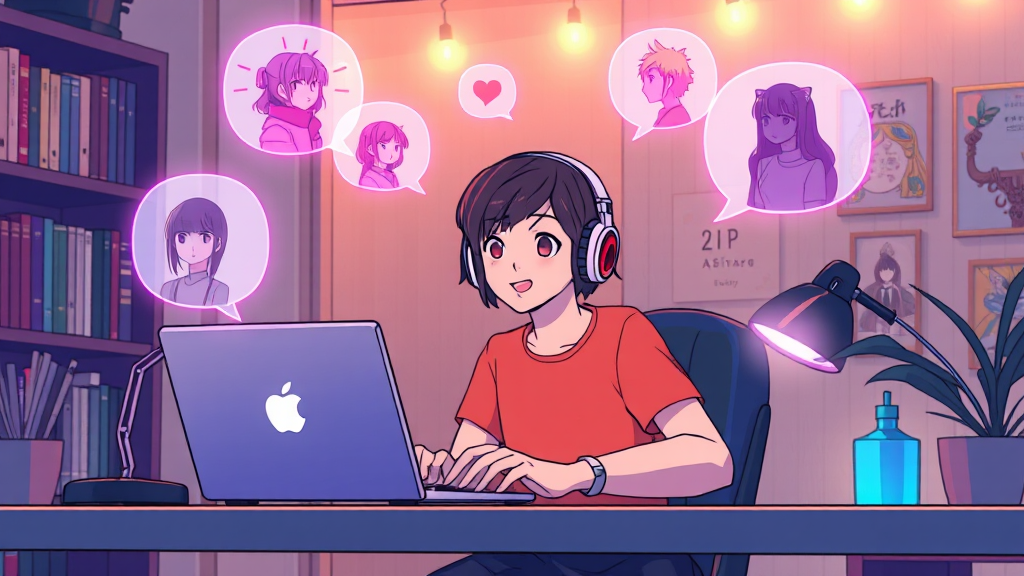
Anime AI Chat: How Conversational Characters Are Reshaping Fan Culture
Anime has always been a medium built on emotional connection. Fans do not simply watch a series and move on; they carry the characters with them, debating motivations, imagining side stories, and writing fan fiction that extends a universe far beyond the final episode. For decades, that connection was one-directional. You watched, you felt, and you imagined the rest. Today, that dynamic is changing. anime ai chat platforms are giving fans something they never had before: a way to hold a conversation with the characters they love, in real time, with responses that feel grounded in personality and story rather than generic scripted lines.
This shift is not just a novelty. It is part of a broader movement in which artificial intelligence moves from being a background tool to becoming a creative companion. For anime fans, the appeal is obvious. The characters are already larger than life, already defined by strong voices, quirks, and emotional arcs. Turning them into conversational partners is a natural next step, and the technology has finally caught up with the imagination.
What Makes Anime AI Chat Different From Generic Chatbots
Anyone who has used a general-purpose chatbot knows the feeling of talking to a polite but forgettable assistant. Anime AI chat is a different experience entirely. The goal is not to answer trivia questions or schedule appointments. The goal is to embody a character, complete with tone, vocabulary, emotional range, and backstory awareness.
When you chat with anime AI characters, the conversation is shaped by personality. A stoic swordsman does not respond the way a cheerful magical girl would. A mischievous rival does not offer the same comfort as a gentle mentor. The best platforms treat character design as a writing problem as much as an engineering one, carefully tuning each persona so that responses feel consistent across hundreds of messages. That consistency is what separates a memorable interaction from a forgettable gimmick.
There is also the matter of context. A good anime AI chat remembers what you discussed earlier, references your shared “history,” and adapts its mood based on the direction of the conversation. This creates a sense of continuity that mirrors the way relationships develop in a long-running series. You are not resetting to zero with every message; you are building something over time.
The Craft Behind a Convincing Character Voice
Creating a believable anime character in text form is harder than it looks. Writers and developers have to balance several competing priorities at once. The character must feel authentic to fans who know the source material, but also accessible to newcomers who are meeting them for the first time. The dialogue must be entertaining without becoming a parody of itself.
One of the most important techniques is restraint. A character who overexplains their own personality quickly becomes tiresome. The strongest personas reveal themselves through word choice, rhythm, and the small details they notice. A character defined by loyalty might instinctively ask about your day before talking about themselves. A character defined by pride might deflect a compliment with a sharp joke. These micro-behaviors are what make a conversation feel alive.
Another factor is emotional range. Fans do not want a character who is always cheerful or always brooding. They want someone who can shift naturally depending on the moment. That means the underlying model needs to understand not just what was said, but how it was said. Tone, pacing, and even punctuation become part of the performance.
Why Fans Are Drawn to Conversational Storytelling
There is a reason this trend is growing so quickly. Anime fandom has always been participatory. Fans create AMVs, cosplay, fan art, and elaborate theories. Conversational AI adds a new layer to that participation by letting fans step inside the story rather than simply observing it.
For some users, the appeal is creative. They use anime AI chat as a brainstorming partner, testing dialogue ideas for their own fan fiction or exploring “what if” scenarios that the original series never addressed. For others, the appeal is emotional. After a long day, talking to a familiar character can be genuinely comforting, especially for fans who feel isolated or who live far from a community that shares their interests.
There is also a social dimension. Many platforms allow users to share interesting conversations, compare character interpretations, and discover new personas recommended by other fans. This turns a solitary activity into a shared one, which is exactly what fandom has always been about.
How to Get the Most Out of an Anime AI Chat Session
New users often start with a simple greeting and then freeze, unsure what to say next. The good news is that these systems are designed to be conversational, not formal. A few practical habits can make the experience much richer.
First, give the character something to react to. Instead of asking a generic question, describe a situation. Tell them about a problem you are facing, a story you just finished, or a decision you are weighing. Characters come alive when they have something to respond to emotionally.
Second, embrace roleplay. You do not have to stay in your own identity. Many fans enjoy inventing a persona, a setting, or a shared history with the character. This unlocks a deeper kind of interaction and often produces the most memorable moments.
Third, be patient with the first few messages. Like any relationship, a conversation takes time to find its rhythm. The best exchanges usually happen after you have established a bit of shared context and the character has had a chance to settle into their voice.
Finally, explore beyond your favorite series. Some of the most surprising conversations come from characters you would not expect to enjoy. A side character from a niche show can sometimes be more engaging than a main protagonist, precisely because they have more room to surprise you.
Ethics, Originality, and the Future of Fan Interaction
As with any new technology, anime AI chat raises important questions. Who owns a character’s voice? How do creators feel about fans interacting with AI versions of their work? What happens when a persona drifts away from its original source?
Responsible platforms address these questions directly. They focus on original characters, respect intellectual property boundaries, and give users clear expectations about what the experience is and is not. The goal is not to replace the original stories or the artists who made them. The goal is to celebrate those stories in a new format, the same way fan fiction and fan art always have.
Looking ahead, the technology will only improve. Voices will become more nuanced, memory will become more reliable, and interactions will feel increasingly natural. But the core appeal will remain the same. Fans want connection, and anime has always been one of the most powerful engines for connection ever created. Anime AI chat simply gives that connection a new place to happen.
Frequently Asked Questions
Is anime AI chat suitable for beginners?
Yes. Most platforms are designed to be welcoming to newcomers. You do not need to know advanced prompt techniques or have deep knowledge of a specific series. A simple, friendly opening message is enough to start a conversation, and the character will usually guide the interaction from there.
Can I chat with anime AI characters from different genres?
Absolutely. The appeal of these platforms is variety. You can move from a shonen action hero to a slice-of-life supporting character to a mysterious antagonist in the same session. Each persona brings a different tone, and switching between them keeps the experience fresh.
Do I need to stay in character while chatting?
Not at all. You can talk as yourself, or you can invent a roleplay persona. Both approaches work well. Many users find that a light touch of roleplay makes the conversation more immersive, but it is entirely optional.
Is anime AI chat only for entertainment?
Entertainment is the primary use, but it is not the only one. Writers use it for dialogue practice, language learners use it to practice conversational skills, and some users find it helpful for relaxation and emotional support. The flexibility of the format is part of what makes it appealing.
Will the conversation remember what we talked about before?
Most modern platforms maintain context within a session, and many also remember details across sessions. This continuity is what allows the relationship with a character to feel like it is growing over time rather than resetting with every visit.
Readers who are interested in this topic will benefit from exploring multiple perspectives and understanding the nuanced approaches that industry leaders recommend. Taking time to research thoroughly ensures better outcomes and more informed decision-making.
Those looking to gain deeper knowledge in this area should consider following expert analysis, staying updated with the latest developments, and engaging with professional communities where these topics are discussed in detail.
A comprehensive understanding of this subject requires looking at both theoretical foundations and practical applications. By combining study with hands-on experience, learners can develop a well-rounded perspective that serves them well in real-world scenarios.
As the landscape continues to shift and evolve, staying informed about emerging trends and best practices becomes increasingly valuable. This ensures you remain competitive and capable of adapting to new challenges as they arise.