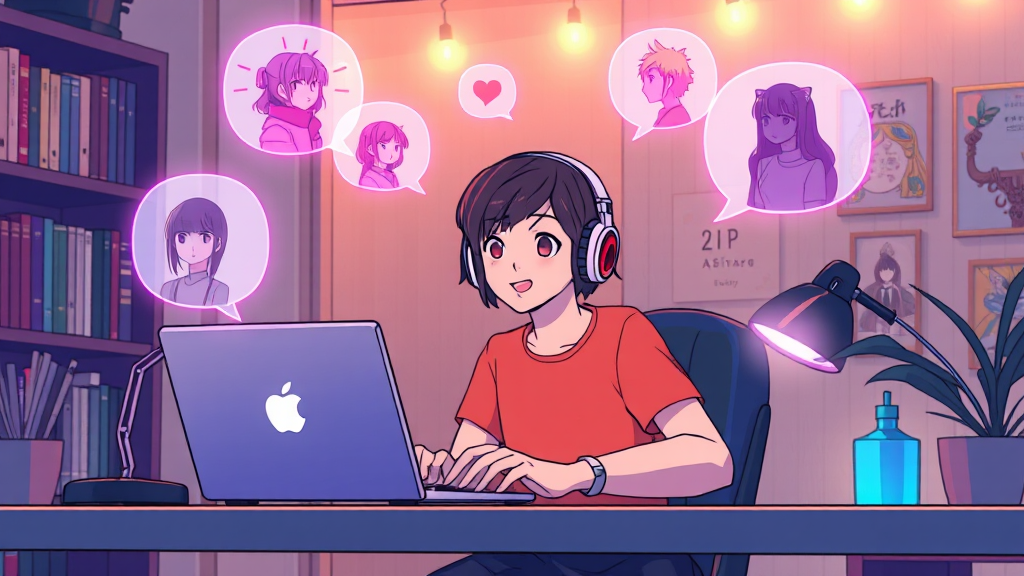
Why We Get a Crush On Someone: The Psychology and Technology Behind Attraction
Few human experiences are as universally felt yet as poorly understood as developing a crush on another person. That flutter in your chest when they walk into the room, the way your attention locks onto their voice in a crowded space, the hours spent replaying a single conversation in your head — these sensations are so familiar that we rarely stop to ask what is actually happening. But the science of attraction is surprisingly rich, and in recent years technology has begun to reshape how, when, and even with whom we form these emotional attachments.
Understanding the mechanics of a crush matters more than ever. We now live in a world where a significant portion of our social and romantic interactions happen through screens, where algorithms decide whose profile we see next, and where conversational AI can simulate warmth and interest with startling accuracy. Whether you are a teenager navigating your first intense feelings or an adult wondering why a particular person still occupies your thoughts, the same underlying forces are at work.
The Neuroscience of Attraction: What Happens in Your Brain
When you develop a crush on someone, your brain releases a cocktail of chemicals that would be impressive even by pharmaceutical standards. Dopamine, the neurotransmitter associated with reward and motivation, surges whenever you see or think about the person. This is the same chemical pathway involved in gambling addiction and drug use, which explains why a crush can feel so consuming. Your brain literally treats the object of your affection as a reward worth pursuing.
Norepinephrine adds another layer. It is responsible for the racing heart, sweaty palms, and loss of appetite that often accompany early attraction. Meanwhile, serotonin levels drop — a pattern also seen in people with obsessive-compulsive disorder. This may explain why you cannot stop thinking about the person, why their image intrudes on your work, and why a simple text message can dictate your entire mood for the day.
The prefrontal cortex, which handles rational decision-making, tends to go somewhat quiet during this phase. That is why otherwise sensible people make questionable choices when they have a crush on someone. The brain is not broken; it is simply prioritizing a powerful evolutionary drive over careful analysis.
Why We Choose the People We Choose
If attraction were purely about physical appearance, the process would be simple. But research consistently shows that a crush on someone is shaped by a complex web of factors, many of which operate below conscious awareness.
Proximity is one of the strongest predictors. We tend to develop feelings for people we see regularly — classmates, coworkers, neighbors, or members of the same social circle. This is called the mere exposure effect: the more we encounter someone, the more familiar and likable they become, provided the initial encounters are neutral or positive.
Similarity also matters. We are drawn to people who share our values, interests, and background, partly because similarity validates our own identity and partly because it reduces the friction of building a relationship. Reciprocity is equally powerful: when we believe someone likes us, we are far more likely to like them back. A smile, a lingering glance, or a thoughtful message can ignite a crush that would never have existed otherwise.
Then there is the mysterious quality we call chemistry. Some people trigger an immediate response that defies explanation. Researchers have identified factors like facial symmetry, vocal pitch, and even scent as contributors, but the combination remains deeply personal. Two people can meet the same person and have completely different reactions, which is why no algorithm can perfectly predict who will fall for whom.
The Digital Age Has Changed How Crushes Form
Twenty years ago, most crushes developed through in-person interaction. You saw someone across a room, struck up a conversation, and let nature take its course. Today, the process is often mediated by screens, and this changes the dynamics in important ways.
Online platforms compress time. Where it once took weeks of casual encounters to build familiarity, a few days of messaging can create the same sense of closeness. This acceleration can be thrilling, but it can also lead to intense feelings for someone you have never met in person — a phenomenon sometimes called a parasocial crush. The brain does not always distinguish between a real relationship and a simulated one, especially when the simulation is well designed.
Social media adds another layer. Seeing someone’s curated highlights — their travel photos, their witty captions, their impressive career updates — can amplify attraction while hiding the mundane reality of their daily life. You are not falling for a whole person; you are falling for a highlight reel. This can lead to disappointment when the real person turns out to be more complicated, which they always are.
Dating apps have turned attraction into a marketplace. With hundreds of potential matches at your fingertips, the temptation to keep swiping in search of someone better is strong. Paradoxically, this abundance can make it harder to develop a genuine crush on anyone, because your attention is always divided. The people who do form strong attachments in this environment often do so by deliberately narrowing their focus and investing time in a single connection.
When a Crush Turns Into Something More
Not every crush becomes a relationship, and that is perfectly normal. Many crushes are transitional — they help us practice emotional intimacy, explore what we value, and learn how to handle rejection. But some crushes do evolve into lasting partnerships, and understanding that transition can be useful.
The key shift happens when a crush on someone moves from fantasy to reality. In the early stage, you are often in love with an idea — a projection of your own desires onto another person. As you spend more time together, you begin to see their flaws, their bad days, and their contradictions. If you still feel drawn to them after that, the crush has matured into something more substantial.
Communication is the bridge between the two stages. Expressing interest, asking questions, and sharing your own vulnerabilities creates the conditions for genuine connection. Many crushes fade simply because neither person takes the risk of moving beyond surface-level interaction. The most successful relationships often begin when someone decides to be a little braver than they feel.
AI Companions and the Future of Emotional Connection
One of the most striking developments in recent years is the rise of AI companions designed to simulate romantic interest. These tools use natural language processing to hold conversations, remember details about you, and respond with warmth and curiosity. For some users, the experience can feel surprisingly similar to having a crush on someone — the anticipation of a reply, the pleasure of being remembered, the desire to share your day.
This raises interesting questions. Is a crush on an AI real? The feelings are real, even if the object of those feelings is not conscious. The brain responds to the pattern of interaction, not to the metaphysical status of the other party. For people who struggle with social anxiety, loneliness, or the pressures of traditional dating, AI companions can provide a low-stakes space to practice emotional expression and explore what they want from a relationship.
That said, it is important to approach these tools with clear eyes. They are designed to be engaging, and their engagement is not evidence of mutual feeling. The healthiest approach is to treat them as a supplement to human connection, not a replacement. They can help you understand your own patterns — what makes you feel seen, what triggers your anxiety, what you value in a partner — but they cannot substitute for the messy, unpredictable, deeply rewarding work of loving another person.
How to Handle a Crush in a Healthy Way
Whether your crush is on a classmate, a coworker, or a chatbot, the same principles apply. Start by acknowledging the feeling without judgment. A crush is not a weakness or a sign of immaturity; it is a normal human response to the possibility of connection.
Next, assess the situation honestly. Is this person available and interested? Are you idealizing them based on limited information? Are you using the crush to avoid dealing with something else in your life? Honest self-reflection can save you months of unnecessary longing.
If the circumstances allow, take a small step toward reality. Send a message, suggest a coffee, ask a question that goes beyond small talk. You do not need to confess undying love; you just need to open a door. If the response is positive, you can build from there. If it is not, you have your answer, and you can begin the process of moving on.
Finally, be patient with yourself. Crushes fade at their own pace, and trying to force yourself to get over someone rarely works. Distraction, time, and new experiences are the most reliable remedies. And if the feeling lingers longer than you would like, that is okay too. The capacity to develop a crush on someone is a sign that you are open to connection, and that is a good thing to be.
Frequently Asked Questions About Having a Crush On Someone
How long does a typical crush last?
There is no fixed timeline, but research suggests that most crushes last anywhere from a few weeks to several months. The duration depends on how much contact you have with the person, whether the feelings are reciprocated, and how much you feed the fantasy through daydreaming or social media stalking. Crushes that are never acted upon can linger longer because they remain unresolved.
Can you have a crush on someone you have never met in person?
Absolutely. The brain responds to patterns of interaction, not physical presence. Online friendships, long-distance connections, and even AI companions can trigger the same emotional and neurological responses as in-person crushes. The key difference is that without face-to-face contact, you have less information about the person, which can lead to idealization and disappointment later.
Is it possible to have a crush on multiple people at once?
Yes, and it is more common than many people admit. Human attention is limited, but emotional attraction is not always exclusive, especially in the early stages. Having a crush on more than one person can be confusing, but it often resolves naturally as you get to know each person better and your feelings clarify.
What should I do if my crush does not feel the same way?
Give yourself permission to feel disappointed. Rejection is painful, but it is also a clean answer that allows you to move forward. Avoid the temptation to convince the other person or to stay close in the hope that they will change their mind. Focus on other relationships, hobbies, and goals. In time, the intensity will fade, and you will likely look back on the experience with more perspective.
Can a crush turn into real love?
Yes, many lasting relationships begin as crushes. The transition happens when you move from fantasy to reality — when you see the other person clearly, flaws and all, and still choose to invest in the connection. Communication, shared experiences, and mutual effort are what turn a fleeting attraction into something durable.